
Learning to Optimize for Networks
Background
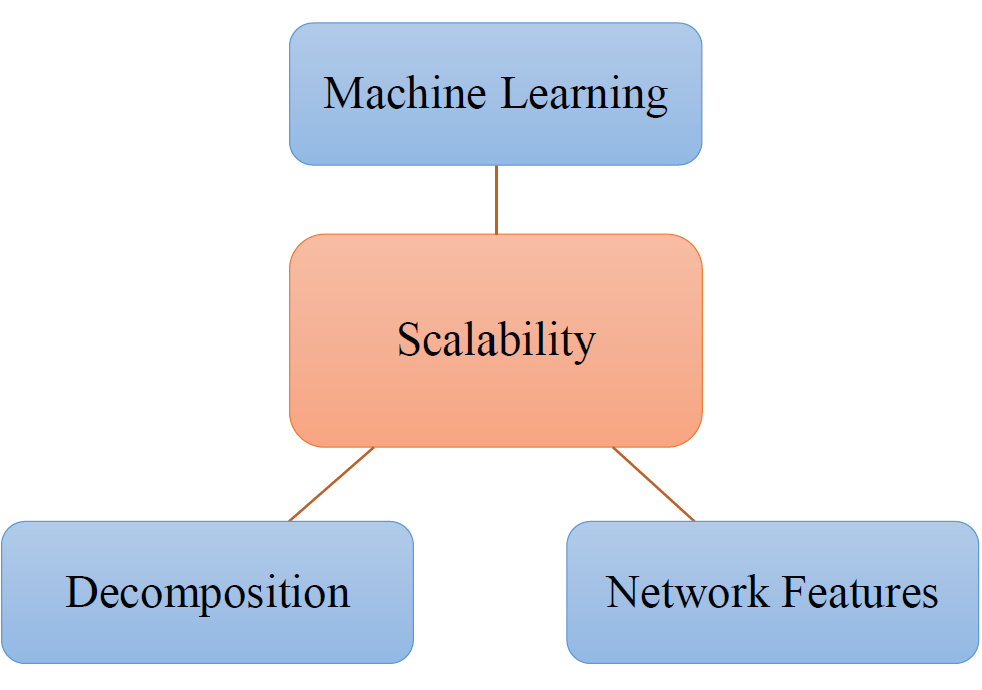
Large-scale networks can adequately capture the structure of complex systems containing thousands of nodes (e.g., cyber-physical-social components) and edges (e.g., mutual interactions). Therefore, network optimization methods have become a popular approach for addressing combinatorial optimization problems in various application domains. The majority of problems are formulated as Mixed Integer Programming (MIP) models, which become NP-hard resulting from the exponential increase in the number of decision variables and the unique structure of the feasible region for large-scale problems. To overcome the computational challenges, leveraging the valuable information during the search process to embed well-informed machine learning methods in optimization algorithms has emerged as a promising research area.
Objective
This research seeks to develop scalable learn-to-optimize and safety-driven algorithms for deterministic and stochastic formulations of MIP models and Markov decision processes on large-scale networks. We use a set of benchmark problems and multiple city-scale networks to demonstrate the added value of our approach compared to baseline optimization algorithms in terms of solution quality, convergence rate, and computational time.
Publications
- Aslani, B., Mohebbi, S., Ougthon. E. (2024). “A systematic review of optimization methods for recovery planning in cyber-physical infrastructure networks: current state and future trends”, Computers & Industrial Engineering, 192, 110224. https://doi.org/10.1016/j.cie.2024.110224
- Aslani, B., Mohebbi, S., (2024). “Learn to decompose multi-objective optimization models for large-scale networks”, International Transactions in Operational Research, 31(2), 949-978. https://doi.org/10.1111/itor.13169
- Aslani, B., Mohebbi, S., (2025). “A learning-augmented branch-and-price for large-scale integrated network design and scheduling problem in road restoration” [Under Review; 2024 Best Track Paper Award of the IISE Operations Research Division].
- Aslani, B., Mohebbi, S., Ji, R., (2025). “Learn-to-Construct Cuts in Nested Benders Decomposition with Application to Large-scale Stochastic Multi-Stage Network Design and Scheduling” [Under Review]. Available at SSRN: https://papers.ssrn.com/sol3/papers.cfm?abstract_id=5895134
- Murali, P.S., Mohebbi, S., (2025). “Safety-Driven Decentralized Maintenance in Networks: An Indicator-Based Reinforcement Learning Approach” [Under 2nd Round of Review]
Funding Source
Mission-Focused Applied Prototyping, Air Force Research Laboratory, AFCENT (2023-2028), Co-PI, $7,442,840.
Center for Resilient and Sustainable Communities, George Mason University (2021-2023), PI, $31,640.
Postdoctoral Scholar and GRAs
Dr. Babak Aslani (Postdoc), Pavithra Sripathanallur Murali (PhD Student), Andrew Moseman (MSc student), Benjamin Barron (MSc student)